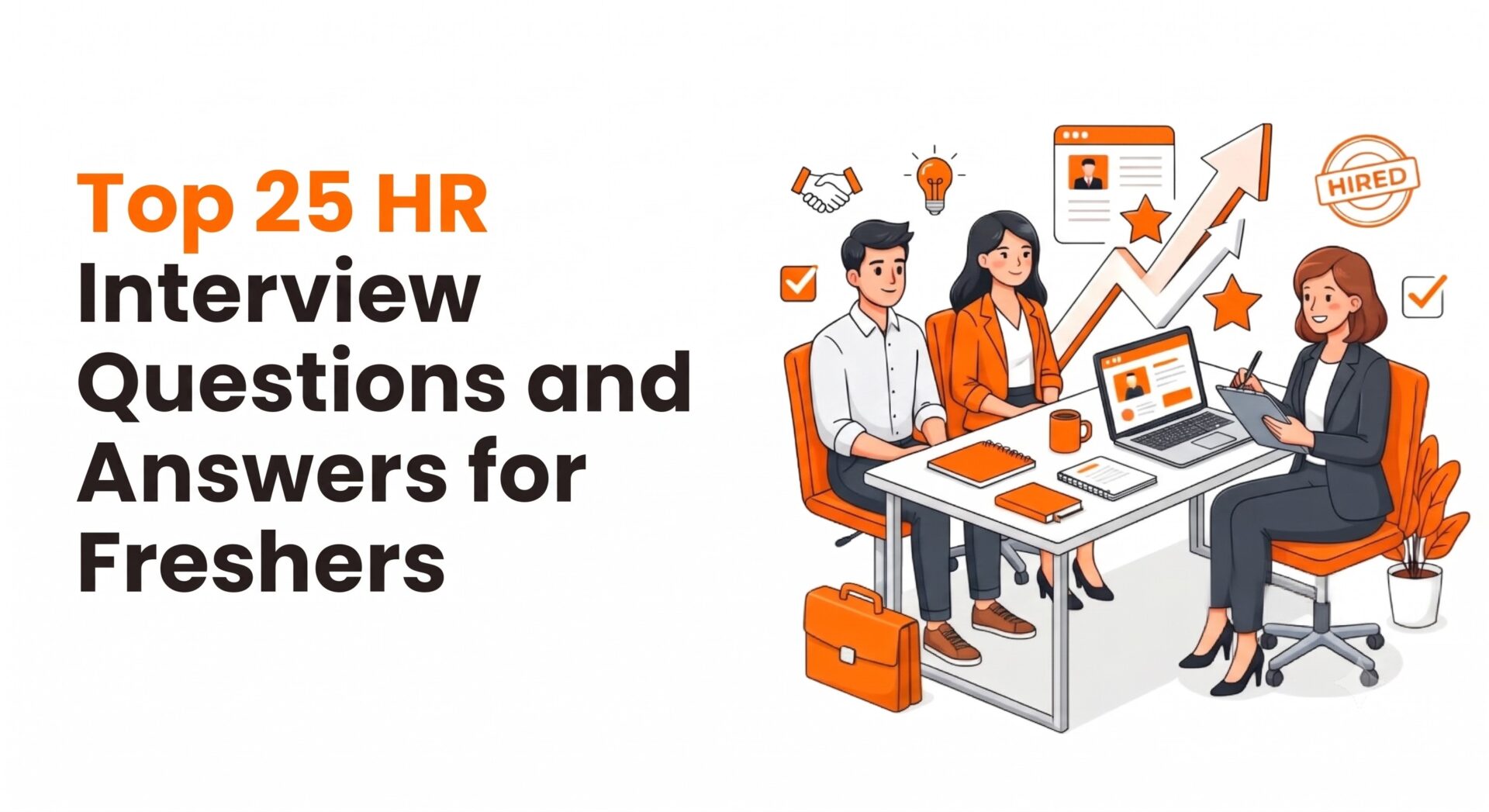
Top 25 HR Interview Questions and Answers for Freshers
Starting your first job can be exciting, but the HR interview can also make you nervous, especially when you are not sure what the interviewer may ask. The good news is that most fresher HR interviews focus on a few common areas such as your introduction, education, strengths, career goals, communication skills, and attitude toward work.
Preparing for these questions in advance can help you answer with more confidence instead of trying to think of everything on the spot. In this guide, you will find 25 common HR interview questions for freshers, along with simple sample answers and practical tips. You can use these answers as a starting point, but try to adjust them according to your own education, skills, projects, and career goals.
How Should Freshers Prepare for an HR Interview?
Before looking at the questions, remember that an HR interview is not only about giving the “correct” answer. The interviewer also wants to understand how you communicate, how you think, and whether your expectations match the role.
Before your interview:
- Read the job description carefully.
- Learn about the company and its work.
- Review your resume.
- Prepare a short self-introduction.
- Think about your strengths, weaknesses, and career goals.
- Revise important details about your college projects or internships.
- Practice speaking your answers aloud.
- Prepare a few questions to ask the interviewer.
Most importantly, don’t try to memorize every answer word for word. Your responses should sound natural.
Top 25 HR Interview Questions and Answers for Freshers
1. Tell Me About Yourself.
This is one of the most common questions asked in almost every interview. Keep your answer relevant to your education, skills, projects, and career interests.
Sample answer:
“I recently completed my graduation in B.Com, where I developed an interest in digital marketing and business operations. During college, I worked on a project related to online marketing, which helped me understand the basics of social media and content promotion. I have also been improving my communication and computer skills. I am now looking for an opportunity where I can use what I have learned, gain practical experience, and grow with the organization.”
Tip: Avoid sharing unrelated personal information. Keep your introduction focused on your professional background.
2. Why Do You Want to Join Our Company?
The interviewer wants to know whether you have taken the time to understand the company and the position.
Sample answer:
“I am interested in this company because the role matches my skills and the area I want to build my career in. I also like the opportunity to learn from an experienced team and work on practical projects. Since I am at the beginning of my career, I am looking for an organization where I can contribute while continuing to develop my skills.”
Tip: Research the company before the interview and mention something specific about the role or organization.
3. Why Should We Hire You?
As a fresher, you may not have years of experience, but you can still demonstrate your value.
Sample answer:
“Although I am a fresher, I am willing to learn and take responsibility for my work. I have a good understanding of the basic skills required for this position and have worked on academic projects that helped me apply them. I am also comfortable receiving feedback and improving my work. I believe I can become a productive member of the team as I gain more practical experience.”
4. What Are Your Strengths?
Choose strengths that are relevant to the job instead of listing too many qualities.
Sample answer:
“One of my strengths is that I learn new things quickly. When I come across something I don’t understand, I usually spend time researching it and practicing until I become comfortable with it. I would also say that I am organized and try to complete my responsibilities on time.”
Tip: If possible, give a small example to support your strength.
5. What Is Your Biggest Weakness?
Avoid saying that you have no weaknesses. Choose a genuine but manageable weakness and explain what you are doing to improve it.
Sample answer:
“Earlier, I used to spend too much time checking my work because I wanted everything to be perfect. I have been working on this by setting realistic time limits for tasks and focusing more on completing quality work within the required deadline.”
The important part is showing that you recognize the weakness and are taking steps to improve.
6. Where Do You See Yourself in Five Years?
The interviewer is generally looking for a realistic sense of direction rather than a perfectly planned five-year career.
Sample answer:
“In five years, I would like to have strong practical experience in my field and take on more responsibility. I want to develop my technical and professional skills and eventually become someone who can independently handle important tasks and contribute to the team’s goals.”
Avoid giving an answer that suggests you expect a senior position immediately.
7. Why Did You Choose Your Course or Degree?
Your answer should connect your educational choice with your interests or career plans.
Sample answer:
“I chose BBA because I was interested in understanding how businesses operate and how different departments work together. During my course, I became particularly interested in marketing and business development, which is why I am now looking for opportunities in this area.”
If your degree and target job are different, explain how you developed an interest in the new field.
8. What Do You Know About Our Company?
Never attend an interview without knowing basic information about the organization.
You can talk about:
- What the company does
- Its products or services
- Its industry
- The role you applied for
- Something relevant from its website or job description
Sample answer:
“From my research, I understand that your company works in the technology services sector and provides solutions to business clients. I also noticed that this position involves customer communication and coordination, which interests me because I enjoy working with people and solving problems.”
Make sure the information is accurate before the interview.
9. Why Do You Want This Job?
Your answer should show a connection between the position and your career interests.
Sample answer:
“I am interested in this position because it gives me an opportunity to start my career in an area that matches my skills and interests. I also like that the role involves practical responsibilities rather than only theoretical work. I believe it would help me develop both my technical and professional skills.”
10. Are You a Team Player?
Most jobs require some level of teamwork, so give an example from college, an internship, a project, or an activity.
Sample answer:
“Yes, I am comfortable working in a team. During my final-year project, we divided responsibilities among team members and had to coordinate our work to complete the project on time. I handled my assigned part and also communicated with the other members when our work was connected.”
11. How Do You Handle Pressure?
Don’t claim that you never feel pressure. Explain how you manage it.
Sample answer:
“When I have multiple tasks, I first identify which ones are most urgent and organize them according to priority. I try to focus on one task at a time rather than worrying about everything together. If I am unsure about a deadline or requirement, I prefer to communicate with the concerned person instead of making assumptions.”
12. How Do You Handle Criticism or Feedback?
Employers generally expect freshers to receive feedback because learning continues after joining a company.
Sample answer:
“I see feedback as an opportunity to improve. If someone points out a mistake in my work, I first try to understand what went wrong and what I can do differently next time. I may ask questions if something is unclear, and then I try to apply the feedback to my future work.”
13. What Are Your Salary Expectations?
As a fresher, it is usually better to remain realistic and show that you are open to the company’s compensation structure.
Sample answer:
“As a fresher, my main priority is getting the right opportunity to learn and build practical experience. I am open to the company’s salary structure for this position and would be happy to discuss the compensation based on the role and responsibilities.”
If the company has already mentioned a salary range, you can respond based on that information.
14. Are You Willing to Relocate?
Answer honestly because relocation may be an important part of the job.
Sample answer if you are comfortable relocating:
“Yes, I am open to relocating if the position requires it. I understand that starting a career may sometimes involve moving to a different location, and I am prepared for that.”
If you have genuine restrictions, explain them politely rather than giving an answer you cannot follow later.
15. Are You Willing to Work in Shifts?
Some companies, particularly customer support, IT services, operations, and international support teams, may require shift work.
Sample answer:
“Yes, I understand that this position may involve working in shifts, and I am comfortable with the requirement mentioned in the job description.”
If you have limitations regarding specific shifts, be honest before accepting the position.
16. What Motivates You?
Keep your answer connected to work and learning.
Sample answer:
“I am motivated by learning new skills and seeing improvement in my work. When I understand something that I initially found difficult and can use it successfully in a project or task, it gives me confidence to learn more.”
17. How Do You Prioritize Your Work?
This question helps the interviewer understand how you organize responsibilities.
Sample answer:
“I usually start by understanding the deadlines and importance of each task. I complete urgent and important work first and then plan the remaining tasks according to their deadlines. If several tasks have the same priority, I clarify with my manager or team lead rather than making an assumption.”
18. Tell Me About a Challenge You Faced.
Freshers can use examples from college projects, internships, competitions, or other relevant experiences.
Sample answer:
“During my final-year project, one part of the project was taking longer than expected because we were unfamiliar with the required software. Instead of leaving it until the last moment, we divided the problem into smaller parts, learned the required functions, and tested them one by one. We were able to complete the project within the deadline.”
19. Tell Me About a Mistake You Made.
Choose a genuine but manageable example. More importantly, explain what you learned.
Sample answer:
“During a college project, I once underestimated the time needed to complete my part of the work. It affected the team’s schedule, so I learned that I should not wait until the deadline is close to start important tasks. Since then, I have tried to break larger tasks into smaller deadlines.”
20. What Are Your Career Goals?
Your goals should be realistic and related to the field you are applying for.
Sample answer:
“My short-term goal is to build strong practical knowledge and understand how work is done in a professional environment. Over time, I want to develop expertise in my field, take on greater responsibilities, and contribute to important projects.”
21. What Makes You Different From Other Candidates?
Avoid criticizing other candidates. Focus on your own qualities.
Sample answer:
“I think my willingness to learn and my approach toward improvement are two qualities that can help me. Since I am starting my career, I know there is a lot I need to learn, and I am comfortable asking questions, accepting feedback, and putting effort into improving my skills.”
22. What Would You Do If You Did Not Know How to Complete a Task?
This is an important question for freshers because employers do not expect them to know everything.
Sample answer:
“First, I would try to understand the task properly and research the issue using reliable resources or available documentation. If I still could not solve it, I would ask a senior or team member for guidance and explain what I had already tried. I think it is better to ask for help at the right time than to continue in the wrong direction.”
23. How Do You Handle Conflict With a Team Member?
Show that you can remain professional during disagreements.
Sample answer:
“If I disagree with a team member, I would first try to understand their point of view. I would explain my own concern calmly and focus on finding a solution rather than proving who is right. If the issue affects the project and we cannot resolve it ourselves, I would involve the appropriate senior or team lead.”
24. Do You Have Any Questions for Us?
This question often comes at the end of an interview. Saying “No, I don’t have any questions” is not always the best way to finish the conversation.
You could ask:
- “What would the first few months in this role look like?”
- “What skills are most important for someone starting in this position?”
- “How is performance usually evaluated for this role?”
- “What kind of training is provided to new employees?”
Choose one or two questions that genuinely interest you.
25. Why Should We Select You as a Fresher?
This question is similar to “Why should we hire you?” but gives you another opportunity to summarize your suitability.
Sample answer:
“I understand that I am at the beginning of my professional career, so I may not have extensive experience yet. But I have built a foundation through my education, projects, and self-learning. I am willing to learn, take responsibility, and adapt to the company’s way of working. Given the opportunity, I would focus on learning quickly and contributing consistently to the team.”
Common HR Interview Mistakes Freshers Should Avoid
Good answers can still lose their impact if the interview is handled poorly. Keep these points in mind:
1. Don’t Memorize Answers Word for Word
Prepared answers are useful, but memorizing them completely can make your responses sound unnatural. Understand the idea and explain it in your own words.
2. Don’t Give Extremely Long Answers
Answer the question directly. If the interviewer wants more information, they can ask a follow-up question.
3. Don’t Lie About Your Skills
If you mention a skill on your resume, be prepared to answer basic questions about it. It is better to honestly say that you have beginner-level knowledge than to claim expertise you don’t have.
4. Don’t Speak Negatively About Previous Experiences
If you have completed an internship, project, or part-time job, avoid blaming teachers, colleagues, or previous employers for problems.
5. Don’t Ignore the Job Description
Your answers should have some connection to the position. Read the job description before the interview and understand what the employer is looking for.
6. Don’t Forget Your Resume
Interviewers often ask questions based on the resume. Be familiar with every project, course, certification, skill, and experience you have listed.
Quick Tips to Perform Better in an HR Interview
A few simple habits can make your interview more comfortable:
- Reach the interview location or join the online meeting a few minutes early.
- Dress appropriately for the company and role.
- Keep your resume ready.
- Maintain comfortable eye contact during an in-person interview.
- Listen to the complete question before answering.
- Speak clearly instead of rushing.
- If you don’t understand a question, politely ask the interviewer to repeat it.
- Use real examples wherever possible.
- Be honest about your experience level.
- Thank the interviewer at the end of the conversation.
Remember that an interview is also an opportunity for you to understand whether the role is suitable for your career goals.
Frequently Asked Questions
What are the most common HR interview questions for freshers?
Common questions include “Tell me about yourself,” “Why should we hire you?”, “What are your strengths and weaknesses?”, “Why do you want to join our company?”, and “Where do you see yourself in five years?”
How should a fresher answer “Tell me about yourself”?
Start with your education, relevant skills, projects, internships or certifications, and career interests. Keep the answer focused on information relevant to the job.
Should freshers memorize interview answers?
No. It is better to understand the main points and practice explaining them naturally. Memorized answers can sound rehearsed and may become difficult to adjust when the interviewer asks a follow-up question.
What should a fresher say about salary expectations?
A fresher can explain that they are open to the company’s compensation structure while considering the responsibilities of the role. If a salary range has already been provided, use it as a reference.
What if I don’t know the answer to an interview question?
Don’t panic or make up an answer. You can honestly say that you are not familiar with the topic and explain how you would approach learning it. For technical questions, you can also explain what you currently understand.
How long should a fresher’s self-introduction be?
A self-introduction of around one to two minutes is usually enough for a standard HR interview. Focus on your education, relevant skills, projects, and career interests rather than unrelated personal details.
Should I ask questions at the end of an HR interview?
Yes, if you have genuine questions. You can ask about the role, training, team structure, performance expectations, or the next stage of the hiring process.
Final Thoughts
Preparing for an HR interview is not about finding one perfect answer for every question. It is about understanding your own background and being able to explain your skills, goals, and experiences clearly.
As a fresher, you are not expected to know everything. What matters is how honestly you communicate, how willing you are to learn, and how well you understand the opportunity you are applying for.
Review these 25 questions, prepare examples from your own college projects or experiences, and practice answering them aloud. The more familiar you become with your own answers, the easier it will be to stay calm and communicate naturally during the actual interview.
SEO Title: Top 25 HR Interview Questions for Freshers
Meta Description: Prepare for your first HR interview with 25 common questions, simple sample answers, practical tips, and mistakes freshers should avoid.
URL Slug: top-25-hr-interview-questions-answers-freshers
Focus Keyword: HR interview questions for freshers
Suggested Category: Interview Preparation